Introduction
When planning a material handling project, the first question is usually not about price but about suitability. A cargo lift has to match the actual load, lifting height, platform size, site environment, and desired safety performance. Making the right choice early saves money, prevents rework, and keeps your operations running smoothly for years.
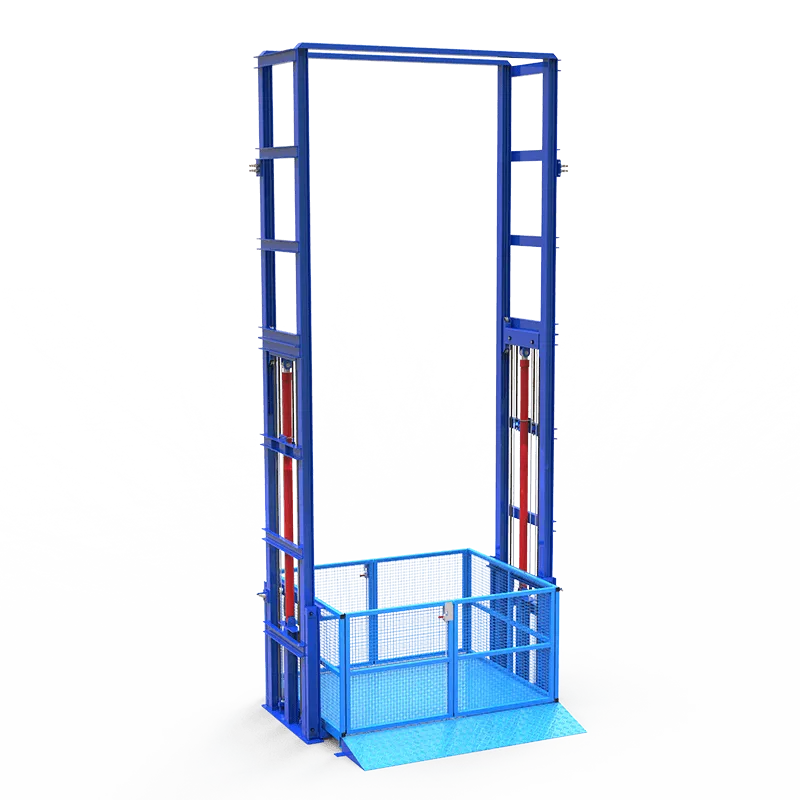
A guide-rail cargo lift is a hydraulic vertical transport solution widely used in warehouses, factories, mezzanines, and multi-floor commercial buildings. Unlike standard elevators, it is engineered for heavier goods movement and can be fully customized to the working site. This guide walks through every parameter you should confirm before contacting a supplier.
Load Capacity
The load capacity is the starting point of any cargo lift design. It determines the structure type, hydraulic power, platform reinforcement, and safety features. If your project handles pallet goods or light industrial materials, the required platform size and power system will differ greatly from a heavy-duty operation.
It is always better to choose a model with some extra safety margin rather than design too tightly. A practical rule is to add 25–50% above your calculated maximum load. For example, if your heaviest pallet is 1.5 tons, selecting a 2-ton capacity lift provides a safer and more reliable operating window.
Two Post vs. Four Post Structure
The load capacity also drives the structural choice:
- Two Post Cargo Lift: Suited to light loads in limited spaces, with a smaller platform footprint.
- Four Post Cargo Lift: The standard model for general and heavier use, offering greater stability.
- Full Mesh Cargo Lift: Adds enhanced safety for projects that require full enclosure or operate in exposed areas.
Travel Height
Travel height determines how much vertical lift is required between the ground and working levels. For warehouse and factory projects, this is one of the most important parameters because it affects cylinder size, hydraulic power, and installation design.
GP Lift cargo lifts support lifting heights up to 15 meters, with flexible stop arrangements. Confirm the exact floor-to-floor distance and the number of stops you need, as these influence the control panel design and limit switch configuration.
Platform Size
The platform should match the cargo footprint and be compatible with the shaft opening. For indoor installations, the guide rail and support structure will limit the workable platform dimensions. It is important to leave adequate clearance for rails and operating safety.
Standard pallet footprints are typically 1000×1000 mm to 3000×3000 mm, but platform size can be fully customized. Always allow extra clearance on each side for safe loading and unloading, especially if you use forklifts or pallet jacks on the platform.
Direction of Access
The access arrangement can vary depending on the site. In some applications, a 180° door arrangement works well, while others need a corner layout or a single-door design to fit the workflow. Confirm how goods will enter and exit the lift, and whether doors are needed on one, two, or more sides.
Pitless Installation
Some projects do not have a pit built into the floor. In that case, a ramp or pitless layout may be a better solution. This is often a key decision point in retrofit projects where civil work is limited. GP Lift offers a loading steel ramp for pitless installation that allows vehicles and pallet jacks to drive onto the platform easily.
Mesh Cover and Protection
If the lift will be exposed or operate in a non-shaft environment, a full mesh cover can provide additional protection and improve site safety. Optional features such as overload warning alarms, low-noise hydraulic power units, and waterproof cabinets can further tailor the lift to your site conditions.
Power Supply
Confirm your local power source before finalizing the design. Industrial cargo lifts typically run on 380V / 415V 3-phase power, but voltage and frequency can be customized to match local standards. Verify the available power at the installation site to avoid surprises during commissioning.
Safety Features
Never compromise on safety. A reliable cargo lift should include essential protection such as:
- Explosion-proof hydraulic valve to prevent uncontrolled descent.
- Emergency stop buttons at each control panel.
- Top and ground limit switches to prevent over-travel.
- Safety outwards doors with interlocks to stop operation when doors are open.
- 1.4m safety railing around the platform edge.
- Overload warning alarm to alert operators when capacity is exceeded.
Choosing a lift with a complete safety package not only protects your team but also reduces liability and downtime.
Cost and Budget Considerations
Budget is always a factor, but the cheapest option is rarely the most economical over the lift’s lifetime. Consider the total cost of ownership, which includes:
- Initial purchase price.
- Installation and civil work (pit, foundation, electrical).
- Ongoing maintenance and spare parts.
- Energy consumption over years of operation.
- Downtime cost if reliability is poor.
A well-engineered lift with a 5-year structural warranty and quality components will typically deliver better long-term value than a lower-cost alternative with limited support.
Final Recommendation
For most projects, the correct solution comes from balancing load, travel, platform size, installation method, and available power. Once these criteria are confirmed, a 3D drawing and technical review can help buyers make a more confident choice.
GP Lift provides free CAD and 3D drawing design for your project, so you can visualize the installation before committing. Share your load, height, platform size, and site conditions, and the engineering team will recommend the most suitable cargo lift configuration.
FAQ
What factors should I consider when choosing a cargo lift?
Load capacity, travel height, platform size, direction of access, installation method, and power source are the most important factors to match your working site.
What is the maximum load and height of GP Lift cargo lifts?
GP Lift cargo lifts support up to 30 ton load and 15m lifting height, with customizable platform size and safety options.
Can a cargo lift be installed without a pit?
Yes, pitless installation with a loading steel ramp is available for retrofit projects where civil work is limited.