Introduction
If your loading area sits at the wrong height for the trucks you receive, every delivery turns into extra work: ramps, manual handling, or a forklift that cannot reach the trailer bed. A dock lift (also written docklift, and often called a loading dock lift) solves that problem by raising and lowering loads to match the trailer, the dock, or the ground.
This guide explains the main types of dock lifts, how to size capacity and platform dimensions, when a pit is required, and how a dock lift differs from a dock leveler and a scissor lift — so you can specify the right unit the first time.
What Is a Dock Lift?
A dock lift is a hydraulic lifting platform installed at a loading dock or transfer point. It moves pallets, cages and carts between two or more levels so that material handling equipment — usually a pallet truck or forklift — can roll on and off without ramps.
Typical duties include:
- Loading and unloading trucks where the trailer bed and dock are at different heights
- Transferring goods between ground level and a raised dock or mezzanine
- Serving multiple trailer heights with a single piece of equipment
- Replacing fixed ramps where the height difference changes from truck to truck
Types of Dock Lifts
Scissor dock lift
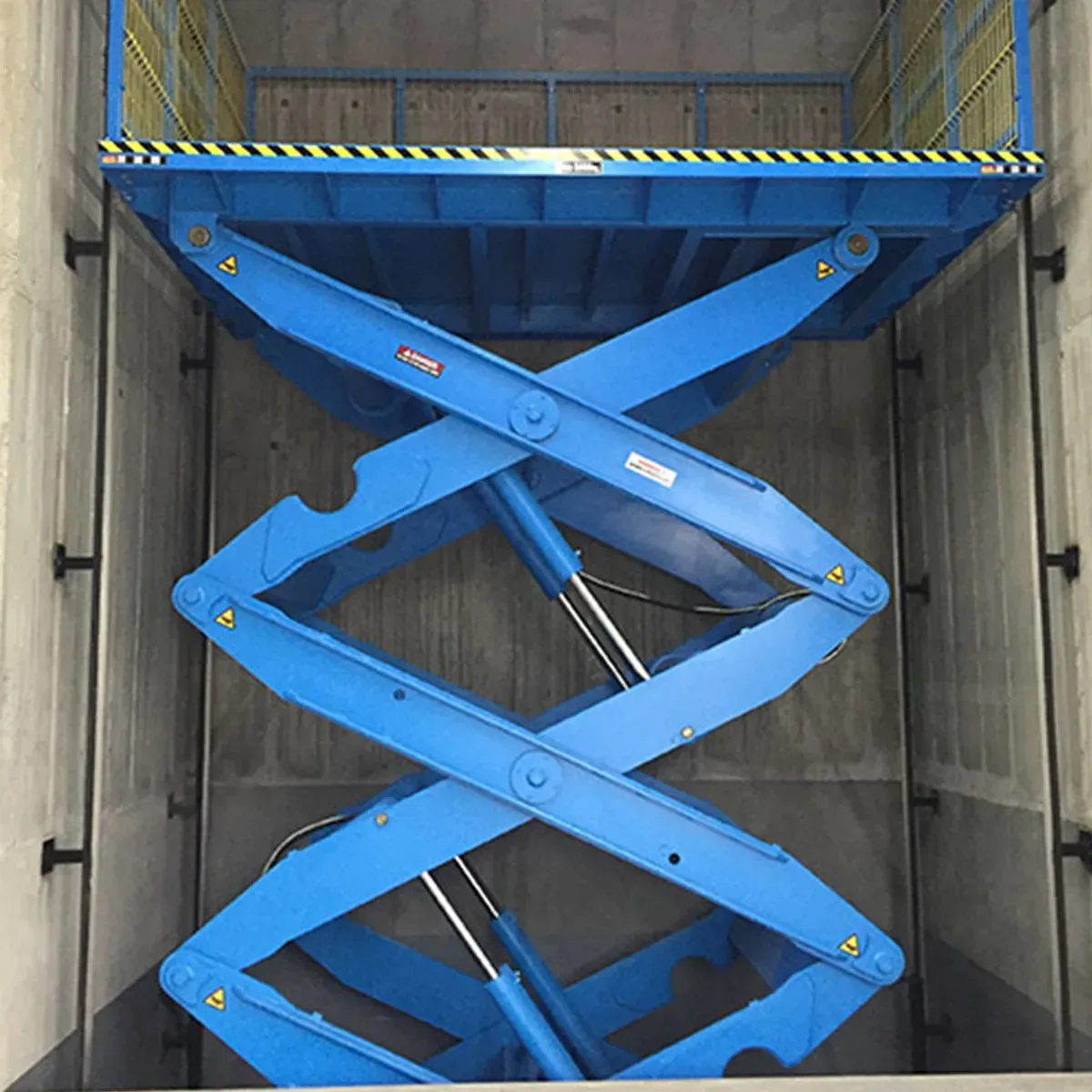
The most common design. A hydraulic scissor mechanism raises a platform vertically inside a pit or on a surface frame. Scissor dock lifts offer high capacity, a large platform, and stable vertical travel with no horizontal movement.
Vertical (guide-rail) dock lift
A guide-rail lift moves the platform up and down along fixed rails. It is used when the travel distance is larger, when the platform must be fully enclosed, or when goods need to reach a mezzanine rather than a trailer bed.
Portable dock lift
A portable unit on casters or wheels can be moved to different loading points and needs no pit and no civil work. It is the practical choice for leased buildings or sites with several loading positions.
Low-profile / surface-mounted dock lift
A surface-mounted lift sits on top of the floor and uses a short ramp for access. It is the simplest retrofit when cutting a pit is not possible.
Sizing a Dock Lift: Capacity and Platform
Load capacity
Standard dock lifts cover roughly 1,000 kg to 10,000 kg (1–10 tons). When calculating capacity, add together:
- The goods on the pallet
- The pallet, cage or cart itself
- The pallet truck or forklift that drives onto the platform
Selecting capacity on the goods alone is the most common specification mistake.
Platform dimensions
The platform must be long and wide enough to hold the load and the handling equipment. A typical sizing check:
- Pallet footprint plus clearance on all sides
- Enough length for the pallet truck forks to enter and exit fully
- Additional width if the load is handled from the side
Travel and closed height
Confirm the lowest and highest positions the platform must reach. Pit-mounted lifts keep the closed height flush with the floor; surface-mounted lifts add their own closed height plus ramp to the working level.
Dock Lift vs Dock Leveler vs Scissor Lift
These three are often confused. The table below shows where each one fits.
| Criteria | Dock Lift | Dock Leveler | Scissor Lift (standard) |
|---|---|---|---|
| Function | Raises/lowers loads across a height range | Bridges the gap at a fixed dock | Raises loads vertically |
| Travel range | Large | Small (dock height only) | Medium to large |
| Serves ground level | Yes | No | Usually yes |
| Typical capacity | 1–10 tons | 6–10 tons | 1–10 tons |
| Needs a pit | Optional | Usually yes | Optional |
| Best for | Variable vehicle heights and multi-level transfer | Fixed dock with similar trailer heights | In-plant vertical transfer |
If your trailer heights vary a lot, or if you also need to load from ground level, a dock lift is the better choice. If your dock height is fixed and trailers are consistent, a dock leveler is usually more economical. For in-plant movement rather than vehicle loading, a hydraulic scissor lift is often the right answer.
Installation and Pit Requirements
The single biggest decision is pit or no pit.
- Pit-mounted: the platform sits flush with the floor when lowered. This gives the most efficient loading and the largest usable height range, but it requires civil work and drainage.
- Surface-mounted: no pit, but the platform plus ramp occupy floor space and add a step for the operator.
- Portable: no pit and no fixed installation, at the cost of a smaller platform and a cable or battery power supply.
For outdoor or wash-down areas, specify a galvanized or marine-grade finish, drainage, and IP-rated controls. Our guide to dock lift safety guidelines covers the site requirements in more detail.
Safety Features Checklist
A compliant dock lift should include, at minimum:
- Safety trip bar / toe guard around the platform edge
- Anti-fall valves (burst valves) on the hydraulic cylinders
- Mechanical maintenance props for servicing under the platform
- Emergency stop and dead-man controls
- Permanent warning signage and load rating plate
- Non-slip platform surface and edge markings
- Guard rails or gates where personnel could be exposed
Confirm which standards apply in your region (for example EN 1570 for lifting tables in Europe, or ANSI/ASME B20.1 for material handling). See the comparison with scissor lifts for shared safety obligations.
Understanding Dock Levelers
Many projects start by pricing a dock leveler and then discover a lift is required instead. If you are still deciding, our dock leveler buying guide explains the trade-offs, cost drivers, and typical specifications for levelers.
Choosing the Right Dock Lift
Work through these questions before requesting quotes:
- What heights must the platform reach? List the lowest and highest positions required.
- How heavy is the combined load? Include the handling equipment.
- Do you need to serve ground level as well as the dock? If yes, a lift is required.
- Can you cut a pit? If not, choose a surface-mounted or portable unit.
- Indoor or outdoor? This drives finish, drainage and control specification.
- How often will it run? Duty cycle affects power unit and cooling selection.
GP LIFT Dock Lift Solutions
GP LIFT builds hydraulic lifting equipment for loading docks, warehouses and multi-level transfer, including hydraulic scissor lifts for dock and vehicle loading, cargo lifts for multi-floor goods transport, and custom platforms sized to your platform dimensions and load capacity.
Share your trailer heights, load weight and site drawings, and our engineering team will recommend the right configuration — pit or surface mounted, fixed or portable.
FAQ
What is a dock lift used for?
A dock lift raises or lowers loads between a loading dock and a truck bed or ground level, so forklifts and pallet trucks can move goods without ramps or manual handling.
What is the difference between a dock lift and a dock leveler?
A dock leveler only bridges the height gap between the dock and the trailer at a fixed dock, while a dock lift physically raises and lowers the load across a much larger height range, and can also serve ground-level loading.
How much load can a dock lift handle?
Standard dock lifts handle roughly 1,000 kg to 10,000 kg (1–10 tons), with heavier capacities available as custom builds. The required capacity should include the load, the pallet or cage, and the forklift or pallet truck.
Do dock lifts need a pit?
No. Pit-mounted dock lifts sit flush with the floor for the most efficient loading, while surface-mounted and portable dock lifts need no pit and can be relocated or added to an existing building.
Can a dock lift be used outdoors?
Yes, with the right specification. Outdoor dock lifts typically need hot-dip galvanized or painted finishes, IP-rated controls and drainage, and a platform surface that sheds water.
What travel height does a dock lift need?
Travel is set by the difference between your highest and lowest vehicle bed heights, plus the dock or ground level you load from. Most loading bays need 1.2 m to 3 m of travel; measure the tallest trailer you serve and add a small margin.
Can a dock lift be installed without a pit in an existing building?
Yes. A surface-mounted dock lift sits above the floor and uses approach ramps, so no excavation is needed. Check the floor load capacity, ramp length and drainage before ordering, since ramps add to the footprint.
How many dock lifts do I need for my loading bays?
One unit per bay that must be loaded independently is the usual arrangement. If bays are rarely used at the same time, a portable dock lift can be moved between them; base the count on peak truck arrivals and the number of forklifts you run.